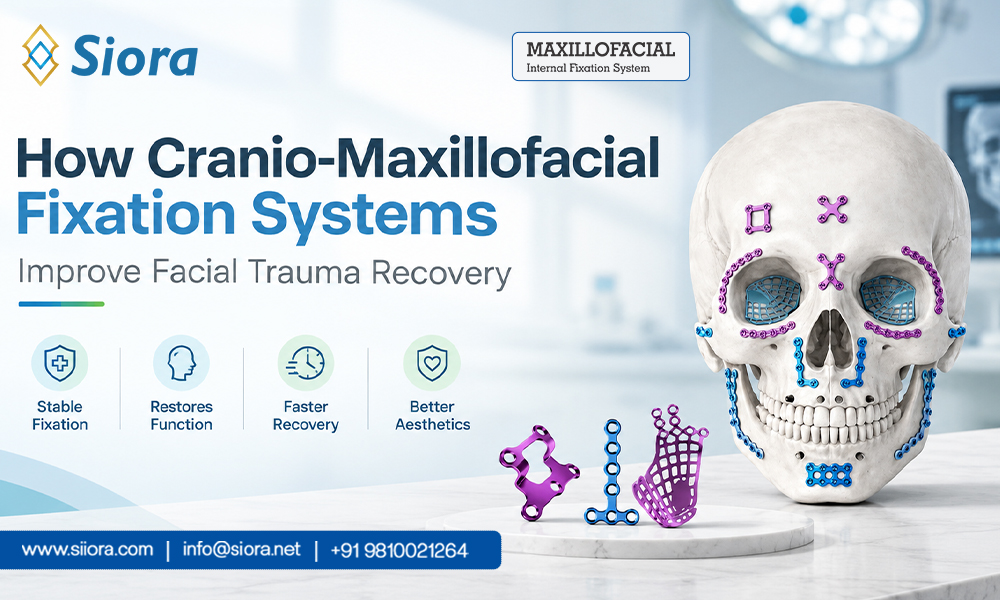
Facial injuries can be far more complicated than they appear. A road accident, sports injury, fall, or other trauma may affect the bones around the jaw, cheek, nose, eye socket, or other parts of the face. Because these structures are closely connected, even a small change in bone position can affect appearance, chewing, speech, breathing, or normal facial movement.
This is where cranio-maxillofacial fixation systems play an important role. These systems provide surgeons with maxillofacial plates, screws, and other fixation components that help stabilize fractured facial bones and support proper healing.
Why Facial Fractures Need Precise Fixation
Facial bones have different shapes, thicknesses, and functional roles. A fracture therefore cannot always be managed with a one-size-fits-all approach. The surgeon needs to restore the normal relationship between the fractured bone segments while protecting nearby anatomical structures.
Stable fixation helps keep the repositioned bone fragments in place during the healing period. This can reduce unwanted movement at the fracture site and create better conditions for bone healing. Depending on the location and severity of the injury, surgeons may select different plate designs and screw configurations.
Supporting Bone Stability During Healing
One of the biggest advantages of a craniofacial fixation system is mechanical stability. After a fracture is reduced, fixation plates can help maintain the desired alignment while new bone gradually forms.
This is particularly important in areas that experience regular movement. For example, fractures involving the mandible are exposed to forces generated during chewing and speaking. A properly selected fixation system can help provide the stability required for the bone to heal without unnecessary displacement.
Helping Restore Facial Structure
Facial trauma is not only a medical concern. Changes in facial symmetry can have a significant effect on a person’s appearance and confidence.
Anatomically designed fixation plates can assist surgeons in restoring the natural position of fractured bone segments. When the underlying structure is accurately reconstructed, it can contribute to better facial contour and symmetry after healing.
For complex injuries, low-profile plates can also be useful where soft-tissue coverage is limited or where minimizing implant prominence is important.
Supporting Functional Recovery
Successful facial trauma treatment involves more than repairing a visible fracture. Patients may also need to regain normal functions such as chewing, speaking, swallowing, and jaw movement.
Rigid and appropriately positioned fixation can help create a stable foundation for recovery. In mandibular and midface fractures, restoring anatomical alignment is particularly important because these regions are involved in several everyday functions.
Materials and Implant Design Matter
The material used for fixation implants is another important consideration. Titanium and titanium alloys are commonly used in cranio-maxillofacial applications because of their strength, corrosion resistance, and established use in implantable medical devices.
Modern fixation systems are available in different thicknesses, shapes, and configurations. This allows surgeons to select components according to the anatomical site and requirements of the fracture rather than relying on a single design.
A Combination of Surgical Skill and Reliable Fixation
Maxillofacial fixation systems are valuable tools in facial trauma surgery, but the trauma implant itself is only one part of the treatment. Accurate diagnosis, surgical planning, fracture reduction, appropriate implant selection, and postoperative care all contribute to the recovery process.
As implant technology continues to develop, fixation systems are becoming more adaptable to the complex anatomy of the facial skeleton. With the right approach, these systems can help provide stability, support anatomical reconstruction, and contribute to a smoother path toward functional and structural recovery after facial trauma.

