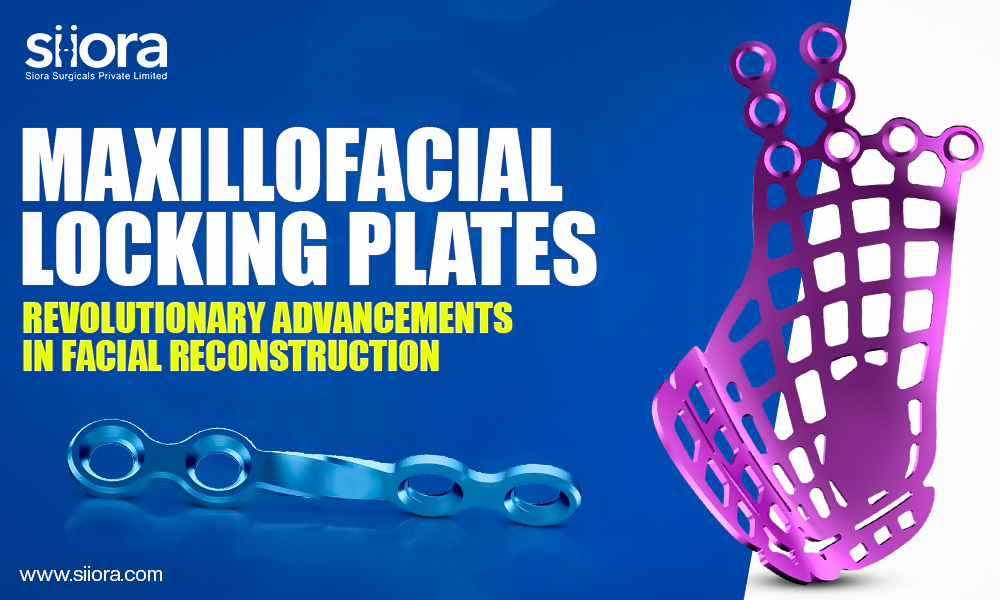
Maxillofacial locking plates have ushered in a new era of facial reconstruction, transforming outcomes for both patients and surgeons. These innovative devices provide stronger fixation, improved stability, and high customization, all leading to faster healing and better facial aesthetics after trauma or surgery.
The Development of Facial Reconstruction: From Conventional Plates to Contemporary Methods
Conventional titanium plates and screws were used for decades to treat facial fractures and deformities. Despite their dependability, these systems had risks like:
• Hardware exposure
• Implant loosening
• Potential need for a second surgery for removal
What Makes Locking Plates Different?
Locking plates are designed so that the screw threads lock directly into the plate rather than only the bone. This creates angular stability, dramatically reducing the risk of movement or hardware failure —a crucial benefit in complex facial regions like the jaw and midface.
Key Advantages of Titanium Maxillofacial Locking Plates
- Biocompatibility and Osteointegration: Titanium CMF plates are well-tolerated by the body. This minimizes the risk of rejection or adverse tissue reactions. Additionally, titanium also shows excellent osseointegration properties, while helping with stable fixation.
- Strength and Stability: Despite being lightweight, titanium posesses great mechanical strength. Hence, it supports fractured bone well, while ensuring good post-surgical results.
- Corrosion Resistance: Titanium is corrosion resistant and it is vital for any implant to succeed in moist environment in the human body.
- Malleability: Titanium can easily be shaped to contour facial bones, allowing for precise facial reconstructions.
Impact on Patients and Surgeons
For patients, these advancements translate into:
- Better facial symmetry and contour restoration
- Less postoperative pain
- Lower complication rates
For surgeons, precision planning reduces guesswork, shortens surgery time, and improves success rates, often minimizing the need for revision procedures.
Challenges and the Road Ahead
Despite their benefits, new technologies come with challenges:
- Higher equipment and training costs
- Continuous need for refinement of bioresorbable materials
However, research strongly suggests that improvements in strength, biocompatibility, and flexibility will make these systems a standard part of facial reconstruction in the near future.
Conclusion
The advancements in the maxillofacial locking plates have completely changed the way facial reconstruction is done. These advancements usher in a new era of surgical excellence by improving patient quality of life while restoring both structure and function.
What is remarkable now might soon become a standard component of facial reconstructive care as developments continue.
If you are looking for a world-class range of maxillofacial implants and other CE-certified trauma implants, contact Siora Surgicals Pvt. Ltd. The company has a huge global presence and is also looking for distributors of orthopedic implants in Brazil to expand its reach.

