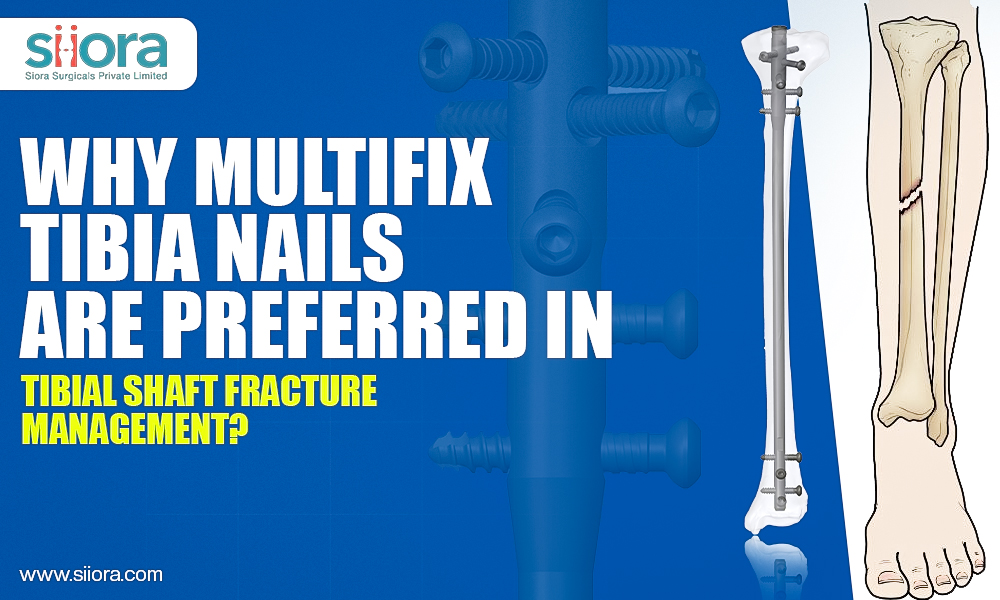
When it comes to orthopedic trauma, tibial shaft fractures stand among the most common long bone injuries. They often result from high-energy trauma like road accidents, sports injuries, or falls. Because the tibia is a weight-bearing bone, any fracture demands careful management to restore stability, function, and mobility. Over the years, intramedullary nailing has become the gold standard for stabilizing these fractures. Among the available options, Multifix Intramedullary Nail Tibia is now widely preferred by orthopedic surgeons, and for good reason.
Advantages of Using Multifix Tibia Nails for Tibial Shaft Fractures
Stability and Versatility
The biggest advantage of Multifix nails lies in their ability to provide rigid fixation with versatility. Unlike older generation nails that offered limited locking options, Multifix nails are designed with multiple locking holes in different planes. This allows surgeons to customize fixation depending on the fracture pattern, whether transverse, oblique, spiral, or comminuted.
This versatility ensures that even complex fractures, such as those with metaphyseal involvement, can be managed effectively. By stabilizing both simple and unstable patterns, Multifix nails reduce the risk of malalignment and shortening, common complications in tibial fractures.
Enhanced Biomechanical Support
A key factor in fracture healing is the mechanical environment around the bone. Multifix nails distribute load evenly along the tibia, maintaining the balance between stability and micromotion required for callus formation. With improved biomechanical support, patients experience faster healing times and reduced risk of implant failure.
Moreover, the interlocking options in these nails allow for both static and dynamic locking. Static locking secures unstable fractures, while dynamic locking promotes controlled compression at the fracture site. This adaptability plays a crucial role in optimizing bone healing.
Minimally Invasive Technique
Intramedullary nailing, in general, is less invasive compared to plating or external fixation. But Multifix nails take this a step further with instrumentation that enables easier insertion through smaller incisions. This results in:
- Reduced soft tissue damage
- Lower infection risk
- Shorter operative times
- Faster recovery for patients
For patients, this means less postoperative pain and earlier return to normal activities. For surgeons, it means more efficient procedures with fewer complications.
Better Alignment and Reduced Malunion
Malunion (when a fracture heals in the wrong position) has long been a challenge in tibial shaft fracture management. The Multifix system addresses this with multiple proximal and distal locking options that give surgeons precise control over alignment. With improved fixation geometry, there’s a significantly lower chance of angular deformities or rotational errors after healing.
Early Weight Bearing
One of the standout benefits of these intramedullary nails for tibia is that they often allow early weight bearing. Because of their superior fixation strength, patients don’t have to remain bedridden or on crutches for extended periods. Early mobilization not only speeds up physical recovery but also reduces risks associated with prolonged immobility, such as muscle wasting, joint stiffness, and blood clots.
Patient-Centered Outcomes
At the end of the day, the success of any orthopedic implant is judged by patient outcomes. Studies and clinical experience show that patients treated with tibial nails report:
- Faster rehabilitation timelines
- Lower rates of implant-related complications
- Higher satisfaction with functional recovery
For many, this translates to regaining independence sooner and returning to work or sports with confidence.
The Surgeon’s Perspective
From a surgeon’s standpoint, tibial intramedullary nails are user-friendly and reliable. The system’s instrumentation is designed for precision, making it easier to achieve accurate entry points and stable fixation. Surgeons value the flexibility to adapt the nail to different fracture scenarios without needing multiple implant systems. This not only saves operative time but also reduces costs for hospitals and patients alike.
Conclusion
Tibial shaft fractures can be life-altering injuries if not managed properly. Modern trauma care emphasizes stable fixation, minimally invasive techniques, and early mobilization, and tibial nails deliver on all three. With their biomechanical strength, versatile locking options, and patient-friendly outcomes, it’s no surprise they have become the preferred choice in tibial fracture management.
For both patients and surgeons, Multifix nails represent progress: a solution that blends engineering innovation with practical benefits, ensuring better healing and faster recovery.If you want international standard range of Multifix Tibia Nails and other orthopedic implants and instrument, explore the inventory of Siora Surgicals Pvt. Ltd. With presence on over 50 countries, the company is also looking for distributors of orthopedic implants in Brazil.
 Site Title